
How to Prevent Tearing During Birth
Women that take my childbirth classes want to know how to prevent tearing during birth, just as much as they want to know how to have a natural childbirth. It's a very important topic that's unfortunately riddled with misinformation.
A doctor once told me that the average first time mom will get a second degree tear during childbirth. Basically, he believes most women tear significantly from childbirth. The underlying assumption is that a woman's perineum is not made to withstand the stress of childbirth.
I call bullshit.
If that were true, then all women, no matter where, when, or how they give birth, would have second degree tears as well. However, this is simply not the case. Many women that give birth in and out of the hospital are able to prevent or reduce tearing by following simple guidelines, many of which are discussed in this post.
The thing is, obstetricians are surgeons and are therefore very comfortable suturing a woman's perineum after birth. Suturing is their jam! Because of this, I think they are less inclined to learn how to prevent tearing during birth, because at the end of the day, they can just sew a woman back together.
However, a postpartum recovery with minimal tearing and suturing is much more pleasant for a woman than if she's stitched to high heavens. It is a worthwhile endeavor to learn how to prevent tearing during birth.
How to Prevent Tearing During Birth
Whether you're planning for a natural birth or a medicated birth, in or out of the hospital, the following are 5 surprising ways to prevent tearing that will change the way you give birth.
1. Choose Birthing Positions Wisely
Squatting Increases Tearing
The first thing we need to talk about is squatting. When in the squatting position, compared to being flat on the back, a woman's pelvis opens 20-30% larger than it would otherwise. A greater outlet equals an easier birth. Isn't that amazing?!
In conclusion, us Americans should squat and push our babies out just like the women in below video, right? Eh, maybe not.
You see, according to this study (and many of the midwives I know), pushing in the squatting position greatly increases the chance of tearing. Squatting, using birth stools, or even squatting with a squat bar, all lead to an increase in tearing.
In a nut shell, if you are a typical sedentary woman, you probably should re-think squatting during pushing. However, if you're like the 1970s Southern Brazilian Indian women in the above video who squats to rest, your body may be able to handle squatting during pushing.
If you're up to the challenge, visit Katy Bowman and teach your body to squat.
Side-Lying, Kneeling, Hands and Knees Decreases Tearing
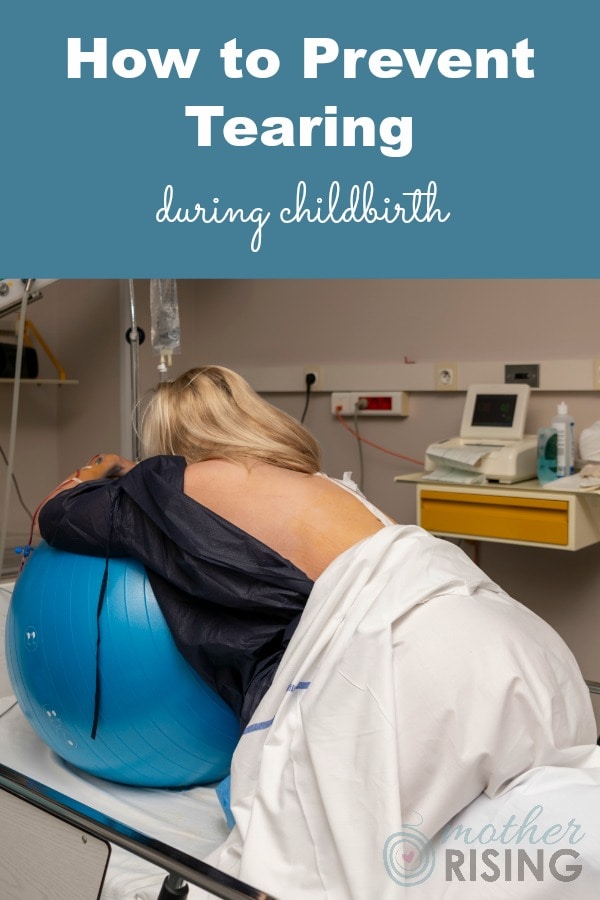
The semi-reclined lithotomy position is what most women use when pushing at hospital births. Despite the convenience this position offers care providers, it's one of the more common mistakes that don't actually prevent tearing.
On the other hand, positions associated with a reduced risk of perineal damage are lateral positions like kneeling or a hands and knees position.
Midwife Thinking says,"I have noticed that when women are left to birth instinctively, they will often move from a squatting position – if they got into one – into a hands-knees position just before the head crowns."
(That's exactly what I did for my births. At some point in all my labors I squatted, but Gabriel was born in the side-lying position, Eden was born in the kneeling position and Mercy was hands and knees.)
If you really want to squat in labor, go for it, maybe just move to hands and knees just before crowning.
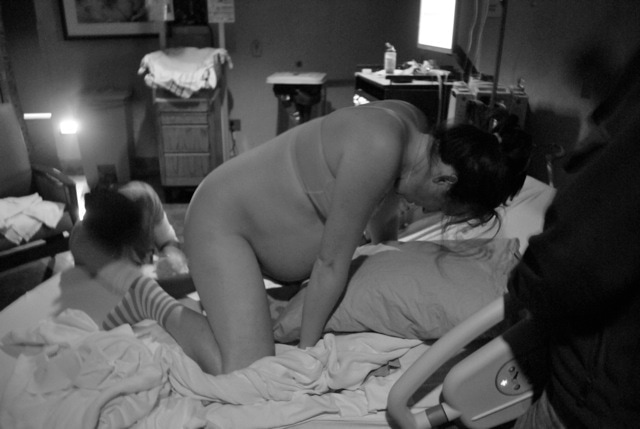
2. During Waterbirth, Continue to Support the Perineum
Unfortunately, it seems that waterbirth, although safe for mom and baby, has an association with tearing. I talked with my midwife, and she agreed with this. She definitely sees tearing with waterbirths.
Maybe this phenomenon happens because care providers are more hands off when a woman is in the water. Or maybe it's because care providers aren't pursuing gentle birth in any venue - land or water. Either way, I have some solutions.
Even when in the water, women should continue to use the information discussed in this article. The same techniques to prevent tearing on land can be used use in water.
- Choose lateral positions like kneeling or hands and knees.
- Provide firm support to the perineum with warm compresses.
- As much as possible, relax.
- After the head is born, wait.
When I gave birth in water I did tear, but it didn't require stitches. A waterbirth isn't necessarily a death sentence to your perineum, but it's definitely something to take into consideration to prevent tearing during birth.
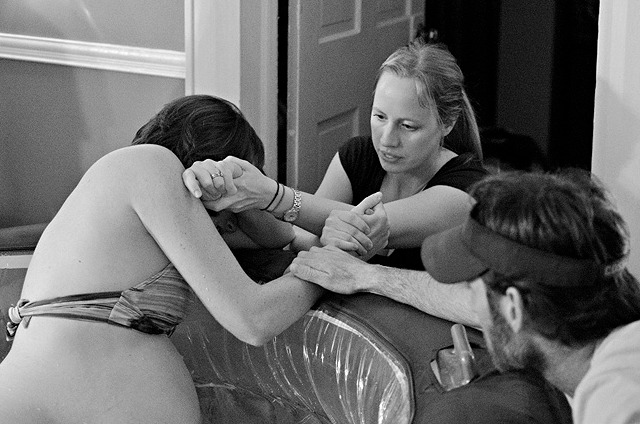
3. Rethink Perineal Massage
Perineal Massage During Pregnancy
Many women wonder if perineal massage during pregnancy can reduce tearing at birth. Perineal massage is when two lubricated fingers are placed in the vagina, and pushed down and to the sides to "pre-stretch" the skin prior to birth.
The evidence says that perineal massage during pregnancy will help a first time mom decrease the chance of an episiotomy. However, in my experience a woman is more or less likely to receive an episiotomy depending on who her care provider is.
If you are a first time mom and are at risk of an episiotomy, perineal massage during pregnancy may help. Hope on over to this post for more information and instructions on how to do perineal massage at home. And remember, it's not really a massage. 😉
Perineal Massage During Pushing
When parents hear the term perineal massage they typically imagine something that’s done during pregnancy. However, many care providers provide perineal massage during the pushing stage of labor to help reduce tearing.
- While mom is pushing, her care provider will sit at the bottom of the hospital bed or stool, gowned up with gloves on.
- Next, they place their outstretched hand towards the nurse, who squirts lubricating jelly on their two fingers.
- After that they take their two fingers and place them in the vagina and push down and to the sides. On a clock, picture 3 o’clock to 6 o’clock, 6 o’clock to 9 o’clock, and then 9 o’clock to 6 o’clock.
- Rinse and repeat.
Watching this looks incredibly uncomfortable, almost painful. And if not painful, then by golly it’s gotta be totally distracting! Sometimes these moms get 30 to 60 minutes of this! The vulva becomes swollen, and leaves me feeling frustrated, mad, and sad.
And what really makes me frustrated is that nurses do this technique too when baby is crowning (before they call the doctor in). Nurses learn from doctors, assuming it’s an evidence based practice.
This hands on approach to supporting a perineum is one of the biggest pet peeves I have about hospital births.
Does Perineal Massage During Pushing Work?
My feelings and anecdotes aside, however, the research does not support the practice of perineal massage during pushing.
“Perineal massage in the second stage of labour did not have any effect on the likelihood of an intact perineum, perineal trauma, pain, or subsequent sexual, urinary or faecal outcomes, but was not harmful.” (SOURCE)
Use Warm Compresses to Prevent Tearing
So far what we've learned is that squatting and lying on our backs increases tearing, but a side-lying, kneeling, or hands and knees position decreases tearing. We've also learned that perineal massage is mostly worthless. So what else can we do to prevent tearing during birth?
Warm compresses have been shown to help decrease the incidence of tearing, which is wonderful news because using warm compresses is so simple.
How to use Warm Compresses at Birth
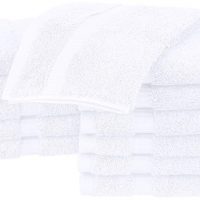
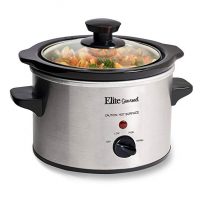
Supplies Needed: All you need is very warm water and washcloths. Here's an inexpensive 24 pack of washcloths. A crockpot can help keep the water warm. Here's an inexpensive 3 quart one that's only $16.
Instructions: Take the washcloth, submerse it in the very warm water, wring it out, and then place it on the perineum with firm support while baby is crowning.
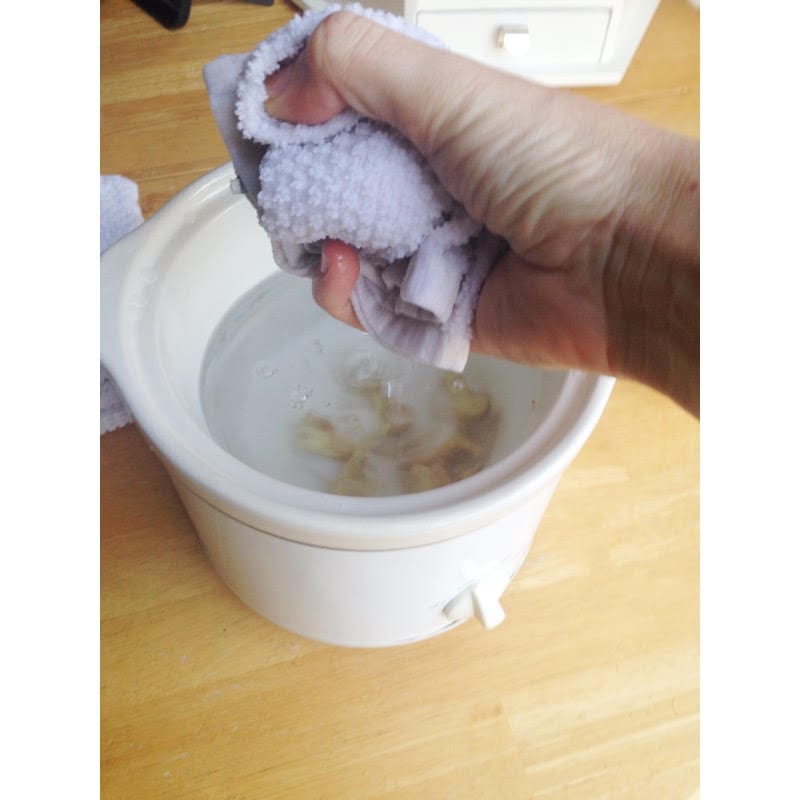
Warm Compresses at a Hospital Birth
I've seen this done in the hospital once and it was the OB's idea (awesome!). He asked the nurse to grab a basin, fill it with warm water and get a stack of washcloths. It took about 2 minutes to setup and mom was so grateful for the extra support.
Ginger Compresses for Pushing
Using warm compresses to support the perineum is standard protocol at out of hospital births. At homebirths you will often find a crock-pot filled with warm water and ginger simmering, in preparation for the pushing stage. Ginger helps reduce inflammation and smells great too!
Once pushing and crowning begins, the crockpot is brought to wherever mom is.
TIP: Make sure the water isn't hot. Once it reaches the desired temperature keep the crockpot on the warm setting. If it's burning your hands when wringing out the washcloths, it's too hot for mom's perineum.
BONUS TIP: Keep a stack of washcloths handy. If a washcloth becomes soiled, you'll have a fresh one right there. 5-10 washcloths will be plenty.
4. As Much As Possible, Relax
Tension plays a role with tearing during birth. Anything a woman can do to reduce tension and encourage relaxation will help the body to do what it instinctively knows to do. An easy way to think about this is to encourage a birthing environment that is conducive to oxytocin and eliminates adrenaline. The same environment that helps make a baby helps get the baby out. 🙂
The following are specific ideas ways to experience a more relaxing birth.
Eliminate Fear
When the body is fearful, it instinctively tenses to protect itself, which makes so much sense. What doesn’t make sense, however, is a tensed body during birth. One way to eliminate fear at birth is to to address fears prenatally, as much as possible, so as to avoid the fight or flight response during birth. It is possible to give birth without fear!
Relax the Jaw
During birth it may be difficult achieve total relaxation if all a woman hears is to “just relax”. Being more specific by pinpointing a specific body part is much more doable. Try saying the following to yourself, or a laboring mother, and you’ll likely be more helpful.
“A relaxed jaw is an open vagina.”
Try Kissing
A fun, and even more effective way to relax the jaw, is to kiss your partner. Not only will the jaw relax (hopefully!), but your body will release more feel-good, labor encouraging hormones like oxytocin and endorphins. According to Ina May Gaskin, she’s never seen a woman kissing her way through pushing that also tears during birth. If that’s not fabulous news, I’m not sure what is. 😉
In the video below, she explains how a chimpanzee, obviously without inhibitions, was using its hand/fingers to arouse itself while it was pushing its baby out (without tearing). Ina May believes that if we get the blood from our head, and move it to our vulva, we won't tear because we'll get REALLY BIG.
Don’t Forcefully Push
If a woman is pushing in a way that is forceful and unnatural, odds are she is experiencing coached pushing instead of spontaneous, undirected pushing. For a woman that is unmedicated, it’s best to be hands off physically, but also with directed pushing.
Coached or forced pushing may sound like a nurse instructing a woman to hold her breath while counting to ten, two to three times during each pushing contraction. It may also look like a doctor or midwife telling a woman to push after baby’s head is out, but between contractions, when she has no urge to push. (You can read more about this phenomenon below.)
Push with Great Strength, Slowly and Gently
Instead, it’s best to push instinctively with great strength, but slowly and gently. Before baby is crowning, it may be helpful to envision pushing with the strength of a gorilla. However, when baby is crowning, pushing slowly and gently is a great way to prevent tearing.
Listen to your care provider as they guide you through these intense moments of birth. You may want to push like a wild woman and “get the baby out”, but anything you can do to allow things to unfold slowly will help keep your lady bits intact.
5. After the Head is Born, Wait
Finally, I’d like to introduce an idea on preventing tearing that is generally not discussed or considered. Minimizing tearing during birth can be facilitated by care providers when they give the opportunity for baby to be born during two contractions – one for the head and the second for the body – and not just one.
After the head is born, by allowing the baby to instinctively rotate on its own and waiting for the mother to experience another involuntary push, the body will be given the space it needs to birth in a gentle way. (BACKED BY RESEARCH, Y’ALL —->>>>> SOURCE)
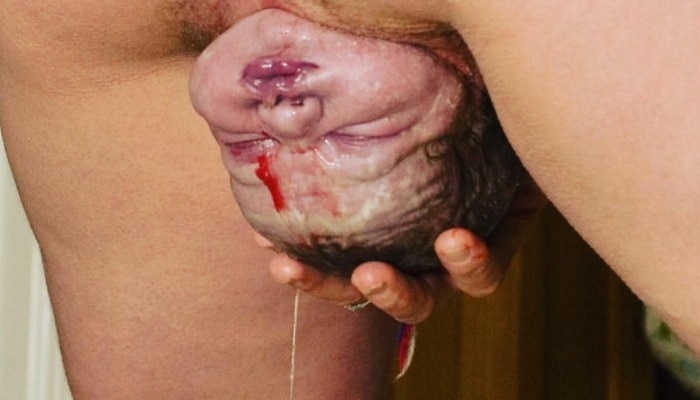
(Photo Credit: Indie Birth Association)
Having said that, I realize this is a tall ask of most care providers. You see, the standard procedure for most is to intervene if the baby’s isn’t completely born within 30 seconds after baby’s head.
I experienced this first hand at my son’s birth. I pushed my son’s head out during one contraction, that contraction went away (as they always do), and I stopped pushing while the rest of his body remained inside of me. My midwife, however, impressed it upon me that I should continue to push and get him out NOW. I remember her saying, “PUSH, Lindsey!”.
Based on how my midwife was acting, it seemed like an emergency. However, years later I looked at my records and there was no huge lapse in time after his head was born. My body was just waiting for the next contraction. I wasn’t given the option to wait for the next contraction because my midwife pulled my son out after that. That’s when I felt myself tear.
30, 30, 30
A few years later, I became a birth assistant and was given the opportunity to witness women and babies having the time and space to deliver baby’s head and body in more than one contraction. It was affirming to see this happen with no adverse affects.
However, I will say that if you’re accustomed to GETTING THE BABY OUT NOW, waiting for the next contraction after the head comes out, will feel like one of the longest waits of your life.
While baby’s between two worlds, it may be best to wait. During this challenging time, grab a cup of tea or sit on your hands. 😉 According to Barbara Harper, if after 30 seconds of waiting nothing happens, move mom into a new position. Every 30 seconds after that, try a new position until baby is born. 30, 30, 30.
Tearing during birth is a common fear of expectant mothers, with good reason, as a local OB once told me that the average first time mother experiences a second degree tear. It would seem that the use of perineal massage during pushing, the preferred method to prevent tearing during birth at the hospital, is not working. So then, what does work? Perineal massage, when done during pregnancy, has been shown to reduce the risk of an episiotomy with first time moms. However, in my experience, this risk is drastically reduced by choosing the right care provider. Have a talk with your care provider and ask them about their episiotomy rates. As an Amazon Associate and member of other affiliate programs, I earn from qualifying purchases.
Tips for How to Prevent Tearing During Birth
Materials
Instructions
Notes
Recommended Products

I'm currently pregnant with baby #4 (well, technically #5 after a miscarriage)... so it's not my first rodeo. But I still like to read articles and so forth. Each pregnancy and birth is different, why not learn as much as you can, maybe try something new? Each of my children have been on the small side (under 7lbs, one of under 6lbs), but I'v e torn with ALL of them. And i'm not a small woman! My first came out with her hand next to hear face, which might have had something to do with it - yikes!
Anyhoo, I brought this up with my midwife recently, asking her if there's some way to prevent tearing all the time - a different position, NOT pushing so hard, etc. She laughed, and admitted it's because I'm pale-skinned. (pause) Seriously?! I had NEVER heard that before, but she said it's true... pale women tend to tear and black woman almost never. Something about the quality of the skin - thickness, elasticity, whatever. So, just like being prone to stretch marks or cellulite or whatever, I think some women may just tear because of their DNA.
I thought it was very interesting because I haven't read this ANYWHERE and kept thinking I must be doing something "wrong."
I've never heard that, but I'm very fair skinned also. Honestly, my first midwife told me it was because I ate sugar at my baby shower. Umm...I don't think so. 🙁 Find a midwife that's confident in her abilities to prevent a tear and doesn't blame you instead! I found new midwives with my other three babies after tearing so badly with my first. They said they rarely have tears. I never needed another stitch with any of the other three, and mine were all about your baby's sizes and one was born with his hand beside his head (not a knick). Read Ina May about tearing and don't just resign yourself that your going to tear. Tell yourself your body was MADE for this and can stretch!
This study doesn't really back that up. http://www.sciencedirect.com/science/article/pii/S0002937803000735 ....
I don't have children myself, however, my younger sister is pregnant with her second! Her first was an extremely difficult and long labor and delivery but our momma (an RN) was there every step of the way. With our mom's recent and unexpected passing, my sister has struggled the whole pregnancy with the thought of not having her there for the delivery. I've got some big shoes to fill so of course I'm trying to educate myself to be prepared and there for whatever she needs. I have to say, this has been the most interesting, informative and inspiring posts I've read yet and I can't wait to share it with her, so thank you!!
I also thought this study was so interesting. I know you posted it in regards to the pale skin comment, which it negated. What I thought was awesome was the fact that it clearly supports what everyone has been sharing about episiotomies. With every single ethnicity the percentage of women with 3rd & 4th degree tearing was SIGNIFICANTLY higher when they had an episiotomy!! It was shocking to see how high the chance of tearing was w/ the episiotomy compared to the low chance of tearing without. Shocking to me that even with these statistics that's it's such a common thing too.
Interesting, about waterbirth. Everyone in the natural birth world is so overwhelmingly positive about it. Of my four homebirths, only the first was in the water, and while it did feel nice as long as it stayed warm, there were definite downsides - particularly that there was one position and one position only that I felt I had enough traction that I could relax (sort of a frog squat with my arms over the side), and I was scared to get out because I'd lose the effects of the warmth. Knowing what I know now, moving around would have helped baby rotate, shortened the labor and probably resulted in me not being so very exhausted by second stage. I was so tense by crowning that I'm fairly sure I would have torn no matter what, but feeling insecurely positioned in the tub surely didn't help.
My subsequent labors have been quite short (~2hrs), and despite the incredulity of my midwives I've planned not to use the tub; there simply hasn't been time, and the shower has sufficed nicely, with less trouble. Of those three, one (who had trouble rotating, I think) I delivered on hands and knees, and the other two quite surprised me by coming down when I was upright, standing and sitting on the toilet. They were both born in asymmetrical squatting-kneeling positions, with zero tearing or even burning, always with my hands down on their heads as they came out. All three were born without a midwife in the room, twice because she hadn't arrived yet and once because she had stepped out to give me my privacy in the bathroom. No pushing beyond a grunt or two.
I wonder how much my quite-atypical birth stories have to do with my and my babies' particular anatomy (one midwife described my pelvis as "highly architecturally sound" ;)) and how much they have to do with my attitude (relaxed) and the undisturbed nature of my births.
You're not alone! Many women find it hard to get their bearings in a big tub. It's like they don't have enough leverage or something.
Any insight into using a "peanut ball"? I just heard about it. I am pregnant with my 3rd and my 1st labor was failure to progress and resulted in a c section. My 2nd I successfully had a vbac but had a 2nd degree tear and had such trama( I did push for almost 4 hours, sunny side up that turned at the last minute) I thought when I got up to walk I had something stuck between my legs; nope, just swollen labia. Anyway it took me like 5 months to heal and not feel like my vagina was falling out ofmy body. And this #3rd time I am again trying for a. 2Vbac and looking for the least amount of trama; Thanks!
Peanut balls are AMAZING and are really helpful, especially for the labors with epidurals. Or even if you're unmedicated, but are in bed because of exhaustion. It helps open up the pelvis which helps to encourage labor progress. A good thing! I think you can't go wrong with a peanut ball.
I HATED the peanut ball to help me to try and give birth on my side !! I waved it away. and it helped my contractions not hurt as much.
i didn't tear but I put it down to the fact that my husband had gone to the car to get my bag and phone my mum as I was told I was only 4cm dilated! He'd only been gone 5 mins when the baby crowned and I had to pant my way through about 6 contractions so he didn't miss the birth!! I think the extra panting helped stretch everything and prevent tearing!!
I wanted to have a natural delivery and the baby was in the correct position but instead I ended up with instrumental delivery (vacuum and spatula) and a big episotomy that restricted my movements for months! It wasn´t painful because they adviced me to go for epidural even though I didn't want it and it was the worst choice ever because I didn´t feel like pushing, I didn't feel my legs for hours and of course they took advantage and cut me because I couldn´t say no. My baby was born with the cord around the neck, lack of oxygen and kept in ICU for hours alone. Fortunately he was and is now (16 months later) a beautiful healthy baby but I still cry when I remember his birth.
I'm so sorry that you weren't listened to at your birth. That wasn't right. You have every right to cry about it even while still feeling thankful for your son. ♥
I am a first time mom and when I had my son, I was on my side just before the pushing stage. They wanted to have me on my back to check how dilated I was but I couldn't physically roll over so they had to check me on my side. I eventuallly got to my back with some help. While waiting for the OB to arrive, the nurses were using perineal massage and having me push him down the canal so that I was almost crowning when the OB arrived. I did tear unfortunately. Overall my hospital birthing experience was fine. But looking back, and planning for future, I would probably want to labor a bit differently.
thanks for commenting Cierra! What do you think you would want to do differently next time? 🙂
Was the grannie midwife energy for a birth of a woman I had helped birth since she was 18. She was having her 5th and 6th babies, cephalic twins. Blood pressure creeping up and in a different hospital than planned with substitute doc. She informed him he would deliver the second one breech if he turned once baby #1 was out. He scurried away. We did a manifestation of babies who remained cephalic and the turning off of pitocin if doc would break presenting water bag. He scurried in when we sent out the request and scurried out.I had taught this baby daddy father #3-#7 Lamaze for the first time (authentic Lamaze out of the 70's/psychoprophlaxis not stuff they pas off as CB education). Mom refused to let the nurse turn up the Pit, in fact made her turn it off. 20 minutes later full blown active labor. The couple was in total communion and after each hard contraction she would close her eyes, he would cradle her face, and he would kiss her forehead. He would kiss her eyelids. He would kiss her eye-sockets, he would kiss her cheeks. He kissed her lips, her neck and her chest, And here would come another contraction with them in total communion, The room was dark. Everyone was silent. Her doula was on the side opposite the Gurdian of Courage (her husband). A German PT student who had attached herself to our birthing circle who had never see a birth was there and in the corner was the mom's best friend from kindergarten*. There was so much oxytocin in the room I thought we might all have orgasms! She bore down slightly and said she had to push. Someone called the nurse who saw the head as we did. The nurse ran out muttering "I told him not to wander off!" My hands were somehow close enough that when she had a spontaneous fetal ejection reflex I simply created a barrier so Jill would not skid off the bed. Mom picked up the baby. I doubt if there were a tear.
THEN, in rushed the doctor, 4 nurses, someone turned on the lights and the staff started screaming at her to push. Contractions stopped. We asked for silence. Contractions began later. Staff members screamed. We asked for silence. Jack, not wanting to come out in to that hostile environment, took forever to emerge. When he finally did, she tore.
He WAS kissing her as she birthed baby Jill! copyright 11-13-16 Janis Bell Bush
It's completely false that perineal support can't be done during a waterbirth. I'm a midwifery student who's done perineal support on every single mom (except one, who chose to catch her own baby and she did her own support) who chose to give birth in the water and we have a very low incidience of tearing.
Otherwise, good tips. Perineal massage is traumatic to watch and to have it done. Not okay. I love the idea of the ginger water for support! Sitz bath herbs would also be another good idea!
I am so glad you left a comment! If you have a moment would you mind giving us some tips or practical advice about how to support the perineum during a water birth? This way we can get that good information out there.
All three of my births were water births. And I never tore not even a little. And I am small framed 5'3" 115lbs and had 8lbs 4oz, 9lbs4oz, 8lbs7oz babies. Its all about relaxing and supporting your perineum.
As I am now a doula this is great info, Thanks for ginger idea I usually just do warm water, but I will add ginger next time.
You're welcome!
I had a 3rd degree tear with my first (and only) but I believe it was because her hand came out next to her head. It was all very quick and I wasn't even offered the option for an episiotomy because it was a quick labor and I wanted to have as little intervention as possible. I'll definitely try these techniques next time. In your opinion will I be less likely to tear with the next? Pending uninvited hands lol...
Yes! Many women tear less when they give birth. Especially when there are no hands... 🙂
Did the author read the one and only study that she used to support her conclusions? The study concluded that "Anal sphincter injury occurred in 3.5%" ... of that 3.5%, only 1.8% were squatting!!! That is NOT a recommendation against squatting. Very disappointed in the lack of fact based evidence.
I've only given birth once so far, but I had a fourth degree tear! I said I didn't want an episiotomy but the doctor did a lot of massage (which hurt real bad) and I am very stubborn and wanted labor to be over so I pushed more and longer than my body was ready for... I appreciate the info about the washcloths and massage. I had already decided that I will listen to my body in the future, but now I have a couple other ideas in my bag 🙂 Thanks!
You're welcome!
FINALLY! Someone who posted the truth about perineal massage. I'm an L&D nurse and I have seen so many women so swollen from perineal massage that at times, it results in C-section because mom swells to the point where she can't physically move the baby past her vulva.. And yes, GREAT observation about how uncomfortable--and instinctively ugly--perineal massage just looks! I don't think it's fair to call this technique "massage" as it sounds like it's a gentle, comfortable process. But in reality, it is not! It's a provider's excuse to physically widen and stretch the vagina to shorten the pushing phase when the vagina does not need their help and likely will not benefit at all from their interference. It is notable that most women who are unmedicated do NOT tolerate perineal massage at all! I've seen several midwives attempt perineal massage in unmedicated gals only to get snapped at: "Get your fingers out of there!" That says a lot on its own.
Great advice overall, especially regarding avoiding the lithotomy/traditional squatting positions (unless you're a gymnast, ballerina or accustomed to sitting in a cross-legged style). Some of the most traumatic births I've seen are births where the provider routinely has the staff push mom's knees up toward her ears and pull her feet back and up while in lithotomy, thus combining the squatting/lithotomy positions. If you want to tear, that's a fabulous way to make it almost a guarantee.
Soooo... I love your comment and I love your blog. I think if we were to meet in RL we would get along just fine. 🙂
Thanks and right back atcha! 🙂
I gave birth in the semi squatting position/ reclined position with my knees held near my shoulders ! from my first contraction to delivery was 27 hrs. 10 hrs of active labor. I was tired and never wanted to birth in that position but I had no energy to say no.. >:( I had a 2nd degree tear and swollen bits for a month ! never again am i birthing in that position. even though I have strong legs.
I just had my first baby six months ago and I had a third degree tear. I could not walk or even sit for six weeks after. The recovery was very difficult and I have so much scar tissue now that intercourse is painful. I'm looking into physical therapy for complete healing, but I can say that naturally tearing that much has definitely done life-long damage.
Great article! One expecting Baby #3 and of course labor is right on the top of my mind! With my first, I delivered with a midwife in a hospital. I had the intense urge to push when I was only 8cm. My midwife had my husband (tmi) stimulate my nipples in between contractions to dilate me quicker and my son was born 30 minutes later and only suffered a very minor tear. Obviously, I was fine with it. At that point, you'll do anything to get the baby out lol. With my daughter, I used a conventional OBGYN because we suffered many minscarriages in between our first and second and so we went to a specialist. I was very frustrated when it came Tim to push. I wanted to be hands and knees but they forced me to lie on the bed. They put my legs in the stirrups (while I begged them to stop because it was excruciating) and then I pushed my daughter out in one quick push. I tore so badly he said it was one of the worst he'd seen. I am looking forward to #3 and will be much more assertive about what I want in the hospital room!!
I am a hospital birthing midwife and many times I beg women to listen to their bodies and move accordingly unfortunately in todays society many moms absolutley cant or wont listen to their primal selves.
I frequently try to reposition my moms to protect their perineum as well. My very best friend begged to deliver squatting and I almost had to force her on her back to prevent what would have likely been a 3rd degree due to the position of the baby. She had 3 tiny stitches after it was over and was actually super grateful for the direction.
Also to speak to tear vs snip. Think of the perineum like a hemmed t shirt hard to tear completely through but snip it and it will rip all the way through. "Preventing a tear with an episiotomy" is antiquated medicine. Episiotomy should only be done in an emergency situations. I have only cut 5 episiotomies in my entire career and I have the highest "intact delivery rate" of any provider at my facility mostly because i work with each mom and baby. Some need perineal massage, some need squatting pr on their back or side lying or standing; problems arise when everyone shows up to the delivery with preconcieved ideas of what should/shouldnt be done. EVERY single mom and baby are different as is every labor. Respecting the process is the most sacred thing to do to ensure a good outcome.
Ps love hot compresses.