
The Truth About Delayed Cord Clamping
Delayed Cord Clamping is the practice of postponing cutting a newborn's umbilical cord instead of immediately cutting it during the third stage of labor and is a best practice for moms and babies immediate postpartum.
To some, delayed cord clamping may seem like a "crunchy" thing to do or one of those "birthing fads" but if you think about it, delayed cord clamping was normal protocol long before women could be even considered crunchy. In fact, humans are the only mammals that immediately cut the cord after birth. Dogs, cats, horses, elephants, etc. all seem to have better things to do than to sever the umbilical cord after their baby is born.
Are humans different than all other mammals? Is cutting the newborn's cord immediately after birth the best for human babies? In this post we will address these issues and hopefully dispel common myths about delayed cord clamping. Let's get started!

The Truth About Delayed Cord Clamping
“Another thing very injurious to the child, is the tying and cutting of the navel string too soon; which should always be left till the child has not only repeatedly breathed but till all pulsation in the cord ceases. As otherwise the child is much weaker than it ought to be, a portion of the blood being left in the placenta, which ought to have been in the child.”--- Erasmus Darwin, Zoonomia, 1801
The main source of information for this article came from the Delayed Cord Clamping Grand Rounds. The OBGYN in the film got most of his information from these two studies:
- Distribution of Blood Between Infant and Placenta After Birth
- The Blood Volume of the Newborn Infant and Placental Transfusion
MYTH Immediate Cord Clamping Does No Harm
Sometimes, when my (hospital birth) doula clients request delayed cord clamping (DCC) they are told by their care providers that there's nothing wrong with the modern practice of immediate cord clamping (ICC). The truth, however, is that the babies that receive delayed cord clamping have 40% more blood volume compared to babies that received immediate cord clamping. (source)
40% more blood... is a lot of blood.
Basically, babies whose cords are immediately clamped are phlebotomized or bloodletted. It is my belief that if a baby is supposed to have a certain amount of blood after all is said and done, who are we to say no? But let's dig a little deeper, shall we?
MYTH Babies Are Born with Insufficient Iron Stores
It's true that many babies are born with insufficient iron stores to get them through the first year of life. This is why formula and rice cereal, for example, are fortified with iron. This is also why many pediatricians push table foods that are iron rich.
But get this, babies that received delayed cord clamping are less likely to be iron deficient. In fact, these lucky babies will have enough iron stores to get them through the first six months of life, at minimum.
What this means is that babies are not intended to be anemic in their first year of life. And it could quite possibly be the practice of immediate cord clamping that has caused this anemia.
For those that don't know, iron is a big deal in children. Iron helps neurological development. Basically, it helps babies to develop and get smarter, faster! Giving infants the iron they were intended to receive is important for their development.
Delayed cord clamping allows our children to have healthy amounts of iron stores in their bodies that will support them in their first year of life.

MYTH Delayed Cord Clamping Takes Too Long
Many care providers are in a rush to leave once the baby is born. I hate to say it, but they're really ready to get out of there. To them, their work is done.
I have a hard time envisioning a few doctors in particular patiently waiting for delayed cord clamping to take place. I feel like they would crawl out of their skin. Sitting there and waiting would be too much!
For the care providers that think DCC would take too long... Could you wait just one minute?
Delayed cord clamping causes 40% increase in blood volume, 45% increase in hematocrit, 50% increase in total red cell blood cell volume and 50% of this change happens within the first 60 seconds.
The remainder happens over the following 2-5 minutes.
By waiting only one minute, a baby benefits significantly!
Sure, waiting for 2-5 minutes would be better, but if a care provider is having a hard time coming around to DCC a compromise might be to only wait for one minute.
(reminder: it's never too late to fire your OB!)

MYTH Stripping or "Milking the Cord" Is the Same as Delayed Cord Clamping
As a placenta encapsulator, I have the fun task of inspecting placentas after birth. I find this to be quite fascinating as I can sometimes tell if certain things like delayed cord clamping, or too much traction on the cord (sometimes causing a hemorrhage) has taken place. I feel like quite the detective!
One time I had a placenta that had only a small amount of blood in it. I thought this was great as it seemed that this new baby received DCC and got all the blood it was supposed to.
Come to find out, this baby did not receive delayed cord clamping but "milking the cord" instead. Instead of waiting for the cord to finish pulsing, what the care provider did was squeeze the cord with their two fingers and slide it up towards the baby.
(Visualize squeezing honey out of a honey stick and this will make more sense.)
Upon further investigation I found out that many care providers in my area were (and are currently) practicing "stripping the cord" instead of DCC. I'm assuming that this is because the care providers are not ok with waiting to clamp the cord so as a compromise they are milking the cord. I'm also assuming that they think these two practices are basically the same thing.
The truth is that milking the cord is NOT the same thing as delayed cord clamping AT ALL. Stripping the cord leaves babies with too high of hematocrit levels (too much red blood cells) aka polycythemia.
Delayed cord clamping for at least 3 minutes, on the other hand, maximizes a baby’s blood volume without experiencing the high hematocrit.

MYTH Delayed Cord Clamping Causes Bloodloss While Baby Is on Mom
One of the arguments I have heard against delayed cord clamping is that if the baby is on mom's belly with the cord intact, because the baby is higher than the placenta, the baby's blood will drain down back to the placenta (because of gravity).
The only way this particular doctor would allow delayed cord clamping is if the baby remained below the placenta until the cord was cut.
This is just silly.
The research shows that the baby will receive the same amount of blood if it is 40 cm below the placenta, 10 cm below the placenta or 10 cm above the placenta.
Guess what's 10 cm above the placenta? Mom's chest and belly.
The perfect place for baby to be to receive warmth, attention, care and its blood is on mom.
But get this! The blood flow from the baby to the placenta stops at 45 seconds postpartum, but the blood flow from the placenta to the baby continues long after that! So say a baby was higher than 10 cm, it wouldn't really matter after 45 seconds because blood isn't flowing out of the baby anymore, just in. Isn't that amazing?
MYTH Delayed Cord Clamping Causes Jaundice
Another argument I've heard against DCC is that delayed cord clamping causes jaundice. This is kinda true, but kinda not.
The research shows that DCC does cause higher bilirubin levels, however, these numbers don't mean much because there was no increase in the number of sick babies.
Delayed cord clamping may cause your baby to have jaundice, but it doesn't mean that there's anything wrong.
(I wish more pediatricians were aware of this research because it would prevent a lot of unnecessary jaundice treatments and new parents from freaking out.)

MYTH It Is Better to Immediately Cut the Cord of a Premature Infant
The babies that need all the help they can get are the ones that are born too soon, especially earlier than 33 weeks. At the delivery of a premature baby, typical protocol is to immediately cut the cord and assess the baby in the room on the warmer. Sometimes the baby gets to see mom before she's whisked off to the NICU, and sometimes not.
Premature babies that received 30-45 seconds of delayed cord clamping had significantly less and less severe in intraventricular hemorrhage (IVH).
(IVH is bleeding into the fluid-filled areas (the ventricles) inside the brain. This condition occurs most often in babies that are born early.)
Also, premature babies are less likely to have sepsis if they receive delayed cord clamping.
A tiny baby that is born too early is a scary thing that no parent wants to face. A tiny baby that is born too early that gets sick is even scarier. By allowing a baby 30, 45 or even 60 seconds of delayed cord clamping their chances of getting sick decrease. I say it's time to rethink our post-birth protocol and help our babies out.
If resuscitation is an issue, then the technology to resuscitate while still attached to the umbilical cord needs to be created. We got a man to the moon, I think we can do this.

Delayed Cord Clamping
In conclusion delayed cord clamping is awesome! It...
- Allows babies to have full access to the blood they were meant to have
- Decreases anemia in the first year of life helping babies to get smarter faster
- Can be done in a minute (preferably 3-5!)
- Can help premature babies to stay healthy
- Is what nature intended!
According to Academic OBGYN, and the source for this article, "It is not our job to prove that immediate cord clamping is safe. But to prove that immediate cord clamping is not dangerous."
My Experience with Delayed Cord Clamping
I've had a few questions from Mother Rising readers about what my experience with delayed cord clamping was. All three of my births had delayed cord clamping, but my middle child had the most delayed experience of all. 😉
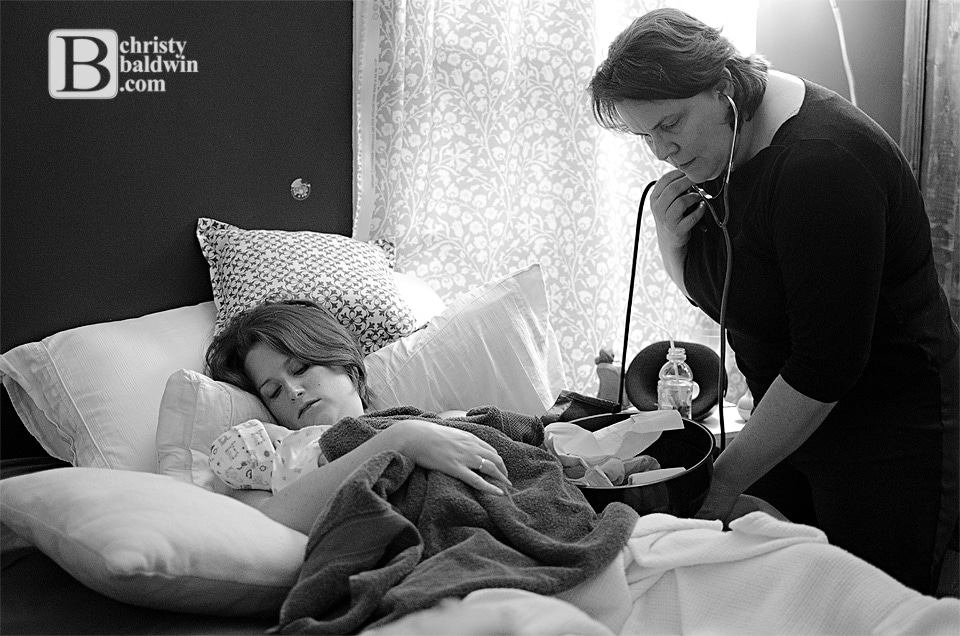
Here I am just after my second baby was born. Do you see that bowl on the bed? That's the placenta, still attached to my baby. It's wrapped up in a chux pad.
My amazing midwife took a more casual approach to cutting the cord. She did all the important stuff, like assess me and baby, FIRST. And when she got around to it, maybe an hour or so postpartum, she cut the cord.
And then she examined it, while Eden and I practiced getting a good latch.

And once Eden was is un-tethered, others held her so I could take a shower. And boy, that's was one of the best showers I've ever had!

Talk to Me!
Alright ladies! Leave me a comment and let me know what's on your mind. Did you have delayed cord clamping? What's your story? What stood out to you most in this article?





Is there anything from peer reviewed journals that I can print out to take to my doctor about this? I'm 30 weeks and have a appointment next week with my doctor. I've already given her my birth plan which includes my desire to do delayed cord clamping but she said she could strip the cord. I thought this was ok, until now. I'd like to give her a print out that shows DCC is better, even for the minute you described. Unfortunately, I don't think I can switch care providers due to finances and insurance. My doctor doesn't seem unreasonable, I'm hoping if I bring her a peer reviewed article, I might change her mind. Thanks! =)
I will absolutely do my best to get this information to you before your appointment. What day is your appointment?
The main source of information for this article came from the Delayed Cord Clamping Grand Rounds. The OBGYN in the film got most of his information from these two studies:
Distribution of Blood Between Infant and Placenta After Birth
http://www.sciencedirect.com/science/article/pii/S0140673669923289
The Blood Volume of the Newborn Infant and Placental Transfusion
http://onlinelibrary.wiley.com/doi/10.1111/j.1651-2227.1963.tb03809.x/abstract
This is an excellent post! I did delayed cord clamping when my daughter was born. I worked with a nurse midwife practice and it was standard procedure for them. It makes me so angry that care providers are resistant to this practice! But not really surprising--so much of mainstream pretnatal/birth care goes against what the evidence says...
I'm glad you had options! Evidence based ones at that. I'm thankful.
I did DCC as well, but before birthing the placenta. I am curious to the difference between waiting those 5 minutes until the cord stops pulsing and waiting until the placenta itself is out.
Have you noticed a difference in the placentas when encapsulating them?
No, not really. Probably because I rarely get placentas from women who wait to cut the cord until the placenta is delivered. I can tell, however, when a cord was stripped or when immediately clamped.
The main difference to me is that the placenta is baby's advocate, and it should remain attached to baby as long as it is still attached to the birthing person. When baby starts to nurse, hormones shift, and their little feet squirming around on the belly stimulates the fundus, both of these important things are signals to the body that baby has landed safety - that is when the placenta will detach naturally. This is one of the last awe-inspiring miracles of birth, and is crucial to hemorrhage prevention, as well as all the benefits to baby listed in this article.
Hasnt much to do with the baby's feet, but with the mums brain releasing oxytocin at the latch.
I don't remember much from our first child other than a verbal remark that it had stopped pulsing before being cut, but the placenta had not been delivered and was instead yanked from the mother's body by what part was hanging out of her. I think this time we will be letting the entire thing be delivered and finalized before any clamping, cutting, or other procedures. It just feels safer this way. Less chance of unnecessary bloodloss for both mother and child.
Before the mid 19, the term early clamping was defined as umbilical cord clamping within 1 minute of birth, and late clamping, as umbilical cord clamping more than 5 minutes after birth.
Hi thanks for an interesting article, I was encouraged by my Drs to have delayed cord clamping at my elective caesarean and it went well, however my baby had polycythaemia and was quite unwell, had quadruple phototherapy resulting in dehydration and weight loss, ng tube feeding and only just got away without an exchange transfusion. It is possible that the polycythaemia could be as a result of my type one diabetes, I am interested if you have any insight. I am particularly thinking if I had another baby should I avoid dcc to prevent this happening again? Thanks!
The AAP and AHA have recommended delayed cord clamping for vigorous term and preterm babies. They do not give a length of time nor do they have a position for non-vigorous babies. This is from the 2017 Neonatal Resuscitation Provider program.
Good news!
I am curious as to how it would work for a c-section. I had an emergency c-section with my first and I never even got to have him on my chest or touch him for that matter. So I know they didn't do DCC. I am pregnant with my second and will be having another c-section and I am requesting that I get skin to skin immediately. Any advice is appreciated!
I have absolutely heard of DCC during a cesarean! Odds are, your care provider doesn't typically do that, but hey! You could be the person that brings change to your community. Google search "gentle cesarean" and I bet you'll find videos of DCC and cesareans. I've seen them. Hope that helps and best of luck to you. ♥
This I should exactly what I was hoping to get information on: DCC with csection. Thanks for the all the awesome info!
This was an excellent article. I came searching for information after a good friend of mine inadvertently delivered at home and the paremedics who were on the phone with her husband told them to tie the placenta off with his shoelace! I was so horrified that they would advise that a dirty disgusting shoelace should go anywhere near mom or baby, I thought maybe there was a serious risk to waiting to clamp. I see their logic, but still, what awful advice.
I would say that they were following their protocol and most people DONT have sterile items in their home.
I just found your article via pinterest, and enjoyed it! While I will likely not be having another child I was still curious to read it. My first was delivered last minute c-section - so very much not the birth I had planned; and while I had a supportive midwife for my second, I had an ob called in to forceps deliver and they basically took over. I was plea-ing on the delivery bed to wait for the cord to stop pulsing but I had extensive tearing they wanted to sew up. Thankfully they gave me 5 minutes. Your article was very reassuring as I had not read that before, but my midwife did mention it to me in the hospital that the the benefits were done in 5 minutes. Thank you for the great article!
You're very welcome! 5 minutes is fabulous.
I really enjoyed this article, as I am in my first pregnancy and expecting twins, I've been doing loads of research to try to help my babies go full term and with high birth weights. I'm curious, being my first pregnancy, how DCC would work with my twins, and if I should expect the process to be slightly different?
I had no idea how to answer this question, so I asked a friend that had twins vaginally and unmedicated, in the hospital. This is what she said:
"There are more factors to consider when their are multiples than with one baby. The chance of a c-section is higher with multiples, so hiring an OB who is willing to delay cord clamping during a c-section would be one factor. Another factor is if the babies shared a placenta or not. Also the interval between birth of baby A and baby B would be a factor. Is there a long time between the births or just a few minutes of frenzied activity? Length of the cords is also a factor. And if the twins has TTTS (twin to twin transfer syndrome) that is another factor. Do I think it has been done before? Yep! Is it probably really statistically unlikely due to logistics and factors beyond the woman's control? Probably."
I would love to see your resources for cord stripping. That's very common here.
I love these kinds of articles! We were going for a homebirth with my first pregnancy, but unfortunately my daughter came at 34weeks and we were unprepared for a hospital birth. While I still had a natural vaginal birth many things happened that I did not like, immediate cord clamping being one of them. Hubby and I were too much in the moment to think to tell them we wanted delayed clamping. My daughter was perfectly healthy, just tiny. There was no reason the doctor needed to clamp so soon. However I could tell he was in a hurry to leave. He decided to stay after his shift, which he then tried to give me pitocin (to speed things up). I refused and she was born maybe 20 minutes later. I held her for a minute before they took her and hubby down to nicu. The doctor gave a few tugs on the cord to try to get the placenta to come out sooner. Usually I get angry when I think about my birth experience with my daughter, but other times I get very sad and want to cry. I feel like both me and my daughter weren't treated with respect. And I wish things had gone differently. I am currently pregnant with our second child, and hoping for a homebirth this time around! I've seen my midwife deliver one of my nieces and witnessed her knowledge of benefits of delayed clamping. My niece got her shoulders stuck and came out not breathing. While the assistant got oxygen ready our midwife waited, feeling the cord pumping oxygen rich blood to my niece. She took her first breath without needing any oxygen. While it was a bit freaky, it helped me to better trust my midwife's knowledge and experience.
It makes me very sad that the birth of a child has become a money making business that has become an inconvenience to doctors.
I found your article by following a "trending" link on Pinterest. Oh how it sometimes knows what we need to see!
I searched "American Academy of Pediatrics Delayed Cord Clamping" and found this article, which may help convince some doctors that are hesitant. It says that the American College of Obstetricians and Gynecologists (ACOG), backed by the AAP, recommends a delay of "at least 30-60 seconds" but also recognizes that the WHO recommends waiting one minute or longer. While it seems that there should be no rush at all to clamp, even one minute is a good start!
http://www.aappublications.org/news/2016/12/21/UmbilicalCord122116
Thank you for sharing this knowledge!
I had a transfer to the hospital from a home birth during pushing phase. I remembered to bring up delayed cord clamping when we got there. The nurses were all cooperative and they said they were ok with my wish. Unfortunately, towards the end of my labor, they had to bring in another OBGYN than the one present there from the start and he hadn't heard my wish nor was he reminded of my wish so he didn't really wait to clamp the cord. By the time I realized it was too late although I did shout 'don't clamp the cord!' and he kind of freaked out and had a guilty look on his face and said, 'oh!' but yeah, too late... it's OK. Thankful for my healthy bright one year old who surprises me with her wonders every day. Pregnant with number 2 right now so hopefully we'll do DCC next time.