Surprise! Pitocin and Postpartum Depression are Linked!
Much to the surprise of the medical community, a 2017 study showed that Pitocin and postpartum depression and anxiety are linked (not a causation but a link). The mothers aren't surprised.
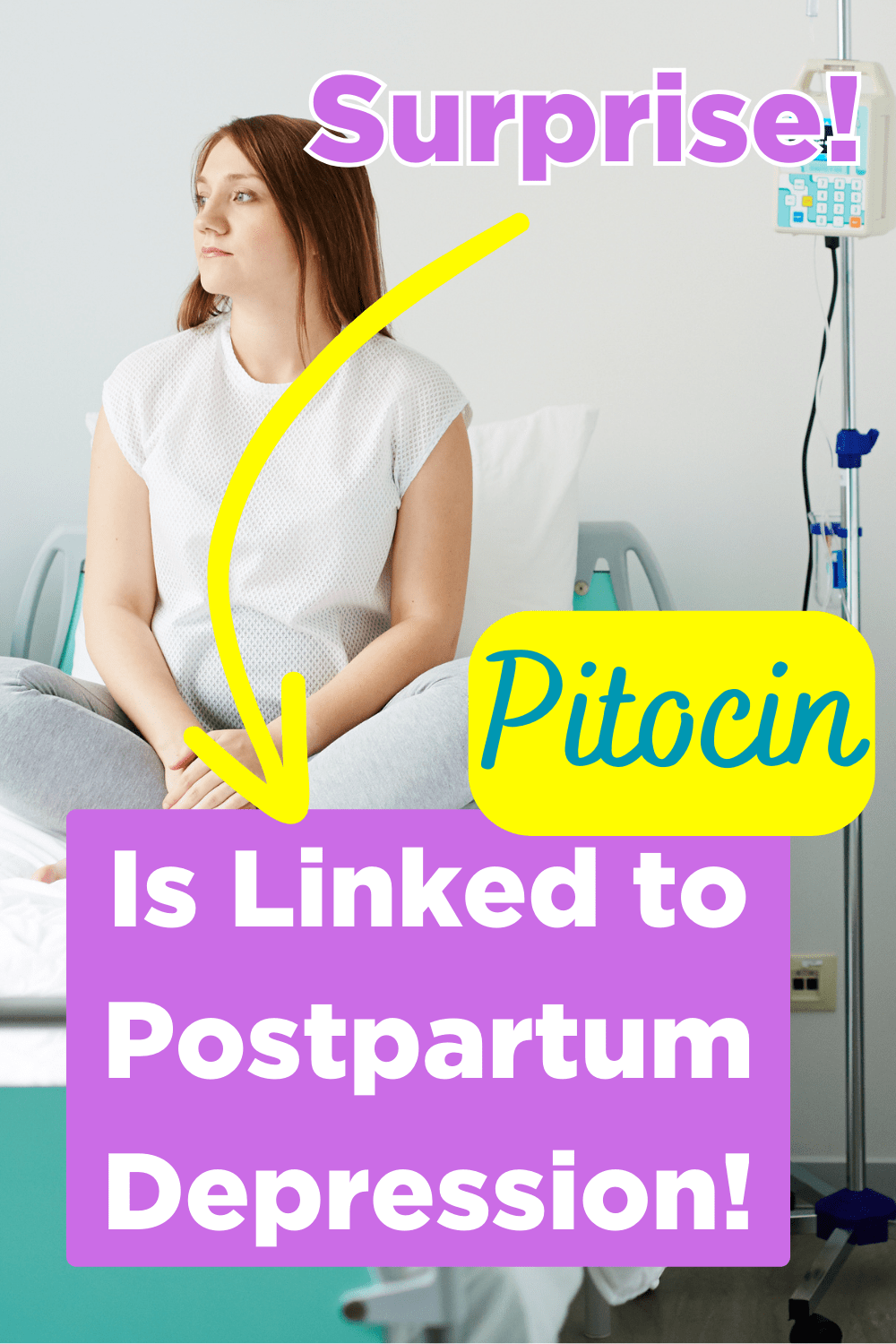
Pitocin®, a synthetic form of oxytocin, is routinely given to women before, during and immediately following birth to induce and augment labor, and to also prevent and treat postpartum hemorrhage.
--->>> According to the 2017 study, women with a history of depression or anxiety prior to pregnancy, receiving Pitocin® increased the risk of postpartum depression or anxiety by 36%. For women with no prior history of depression or anxiety, receiving Pitocin® increased their risk of postpartum depression or anxiety by 32%. Let that sink in for a moment.
I Bet the Numbers Are Even Higher
While I pondered these incredibly high numbers, it occurred to me that the numbers may actually be higher. The information used in the research study came from women that received a diagnosis and/or a psychotropic medication. What about those that didn't seek help?
In my experience, many women do not seek professional help when experiencing postpartum anxiety and/or depression. How many anxious or depressed mothers never confide to their care providers about what they're feeling? Or even worse, were dismissed and told "everything will be fine".
It's Not Just in Our Heads
Even if the numbers may be higher, the research as is, is incredibly validating. Ladies, what you are feeling is not "just in your head". It's real, and it's a big problem (that society has no idea how to handle).
*For a list of symptoms of postpartum mood disorders please visit Postpartum Progress. (Postpartum Progress is a non-profit that aims to raise awareness, fight stigma and provide peer support and programming to women with maternal mental illness.)
Pitocin Is Not the Same as Oxytocin
The strangest thing about the research study was that the hypothesis was the opposite of what made sense to me as a mother and childbirth educator. The hypothesis suggested that synthetic oxytocin, Pitocin, would in fact lower postpartum depression and anxiety.
The underlying assumption I am gathering is that, despite the evidence, medical professionals believe that Pitocin® is the same as oxytocin.
A few years ago I was attending a Pitocin® induction at my local hospital. My doula client was struggling BIG TIME with the sudden wave after wave of strong, painful contractions. Her nurse, not knowing what else to do, told her, "this is just labor, honey". As if what she was experiencing were normal labor sensations. How sad.
Believe me, Pitocin® does not feel warm and fuzzy, and isn't "just like labor". My pitocin augmentation birth was much harder than my first two births. For me, Pitocin® made my active labor phase feel like the transition phase, and lasted far longer than the transition phases I had experienced in my non-Pitocin® births.
Oxytocin is Needed to Mother Well
Oxytocin, on the other hand, is helpful for coping with stress, supporting emotional and mental well-being and also helps with bonding - which are absolutely necessary for a successful transition to motherhood. (source)
Another study showed that women given Pitocin in labor had low oxytocin levels during breastfeeding. This revealed that the exposure to Pitocin® has consequences that last on into mothering. (source)

But What About the Baby?
If oxytocin is an important hormone for becoming a mother and synthetic oxytocin is linked to postpartum depression, anxiety and low oxytocin during breastfeeding. I can't help but wonder - what about the baby?
If oxytocin affects how women transform into mothers, how is this synthetic hormone affecting the baby? How is the baby affected by synthetic oxytocin before, during and after labor? Frighteningly, we have no idea.
Re-Examine Routine Procedures
If Pitocin® is linked to postpartum depression and causes a lack of oxytocin during the postpartum period, maybe it's time to re-evlatulate the use of Pitocin® as it pertains to each woman. (Never mind the baby...)
According to the CDC, induction has more than doubled from 1990 (10%) to 2010 (23%) (source). One source reports the 2020 induction rate was now at 31% (source)... which may be due to the Arrive Trial. However, just because a procedure is routine does not mean that it's a good enough reason to do it.

Another 2020 Study
Beyond the 2017 study, a 2020 study (source) highlighted that higher natural oxytocin in a postpartum woman often showed less incidences of postpartum depression, but couldn't make any conclusions regarding synthetic Pitocin®. Like the 2017 study, they "strongly recommend that rigorous studies examining the effects of synthetic OT exposure on PPD should be performed". For whatever reason, a rigorous study on Pitocin and postpartum depression has yet to be published.
We Need More Research
I'm not suggesting to eliminate Pitocin®, as it is an important life saving tool in modern obstetrics. (Shoot, I've even experienced it first hand!) However, because the consequences of routine childbirth interventions such as Pitocin® on human maternal behavior have been understudied, it would be wise to limit the use of Pitocin® until further research is completed. And if Pitocin® is deemed necessary, it would be wise and compassionate to provide quality postpartum mental health resources, especially to those with high risk factors for postpartum depression.
What if care providers were required to pay for 40 hours of postpartum doula services, a wonderful holistic postpartum mental health resource, to women that received Pitocin®? I bet we'd quickly see the true motivations behind the choices made in the care of new mothers.
Oxytocin is essential for our species to thrive as mothers. Our current methods may be meddling with the mental health of these new mothers - the backbone of society. Is the crumbling mental health of new mothers important enough for us to take action?
Comment on Pitocin and Postpartum Depression Are Linked
Thank you so much for reading! Please leave a comment and let me know your thoughts. What do you think about how Pitocin and postpartum depression are linked?




Hi I am in Australia and here we use Syntocinon. Just wondering is it the same as Pitocin or different drug?
Same drug! Different name.
Thanks!
My second birth was so long ago the practice might no be followed any longer, but following a terrifying labor, our daughter was born as black as coal. I was certain she was dead. She did survive. My dr put me on a "pit drip" at twice the normal dosage. He was convinced that I was going to bleed to death and die because I'm a redhead and this was my first daughter and second birth. The pitocyn was making me cramp worse than any of my contractions during birth. When I would pick up our daughter or try to nurse her the contractions would hit unbearable. The dr refused to reduced or remove the pitocyn. I was feeling I was going to go out of my mind if it continued, so I began to remove the IV. This caused quite a stir among the nurses, one nurse finally removed the IV with the agreement that I would take the orally. They brought me the pills, I flushed them down the toilet. I firmly believe if the pitocyn would have continued any longer I would not have bonded with our daughter because the pitocyn made it impossible to sleep, rest or be near her let alone nurse. At the beginning of my next two pregnancies I had a conversation with my drs. We had an agreement that there would no use of pitocyn during my deliveries or post delivery. The pitocyn drip was the worst experience of my life, and I've had a very big back surgery since. I would not recommend pitocyns use for anyone after my experience!
6 months ago, I had an induced birth pitocin due to preeclampsia and have had the worst postpartum depression. I can definitely see the link. My other 3 births were all natural and I had only mild postpartum depression. This time though, its awful and will not stop.
Synthetic oxytocin can interfere with the delicate orchestration of the mother’s natural hormones during birth, and according to some research, with the baby’s brain and hormones as well.
The Pitocin package insert is very clear about the risks of the drug, warning that it can cause:
uterine rupture
cervical laceration
postpartum hemorrhage
intracranial bleeding
afibrinogenemia
retinal hemorrhage
arrhythmia exacerbation
pulmonary edema
coma
water intoxication
ocular hemorrhage
seizures
anaphylactoid reactions
hematoma
bleeding
hypertension
fetal bradycardia
premature ventricular contraction
blurred vision
hyperbilirubinemia
jaundice
vomiting
nausea
And in the baby:
fetal heart abnormalities (slow heart beat, PVCs and arrhythmias)
low APGAR scores
neonatal jaundice
neonatal retinal hemorrhags
permanent central nervous system or brain damage
fetal death
I’ve noticed this for years, requesting more info. Pitocin is used by far more than it used to be. In the long run, it is NOT your friend.
Can you list your sources/studies? I would like to read the medical report that supports this.
They're linked in the article. 🙂 https://www.ncbi.nlm.nih.gov/pubmed/28133901
Just wondering if anyone has the references for the papers discussed in this article? Would be really interested in reading them.
https://www.ncbi.nlm.nih.gov/pubmed/28133901
totally agree! there has to be more awareness about pitocin. But more then that more awareness to understanding that pregnancy does not have to be strictly 40 weeks! It is just an estimate! so what if it is 42 or 43. There is a time for a baby to come. because just the moment they hear it is over 40 weeks, pressure goes for induction. It is literally a crime to hinder a mother to be from a opportunity to experience natural birth because from thier opinion she is overdue. Many women are healthy and have no complications but still persuaded to do induction.
Hi I was wondering if you had any advice for me, I’m going to have a c section I had complications w my first and I know they will give pitocin after birth is that nessarcy after a c section or is there something I can do to kick in my natural oxytocin for mother and baby bonding? Do I need to detox or pump and dump before feeding for the first time or pump milk before surgery?
I think that would be a good question to ask your surgeon - regarding the Pitocin. As far as pumping and dumping, women typically don't receive medications during a cesarean that would require that. But again, ask your surgeon or anesthesiologist. They will have better insight on what sort of procedures or care may be best for your particular birth and situation. Best of luck!
Please list some natural alternatives to pitiocin. I was given pitocin for my 1st birth because it stalled due to exhaustion & dehydration (wasn't allowed to eat & drink freely). I have heard that things like nipple stimulation can help stimulate hormones to help the labor pick up & progress? Is this true? What other natural methods are helpful? Also, what natural methods can help prevent the possible hemorrhaging after birth? Ive heard maybe breastfeeding? Thanks!
Do you know why you weren't allowed to eat and drink freely? My first thought would be to eliminate the initial problem instead of looking for pitocin alternatives.
Which studies did you use for this information?? In the field to become a doula and a midwife and would love to have more of this information to share with future clients. Having studies is important to a lot of people and just reading a very well written article does not suffice for some.
Thank you! This article has helped many women I've shared it with already
The links to the research articles are linked in the first paragraph. https://www.ncbi.nlm.nih.gov/pubmed/28133901
I'd wonder if having a birth that physically required pitocin also contributed to PPD. If you're sitting there for 24-48 hrs and things aren't going forward, and the mother is getting tired, is pitocin worse than a C-section or better? Is oxytocin production the same across all women and the pitocin reduces it - or was it already not enough in the first place, which is why the pitocin is needed?
This comment in particular:
Oxytocin, on the other hand, is helpful for coping with stress, supporting emotional and mental well-being and also helps with bonding – which are absolutely necessary for a successful transition to motherhood. (source)
Another study showed that women given Pitocin in labor had low oxytocin levels during breastfeeding. This revealed that the exposure to Pitocin® has consequences that last on into mothering [ source] - https://www.ncbi.nlm.nih.gov/pmc/articles/PMC3947469/
----
^Well, that's a big assumption. How do we know there was just not enough being produced by the mother to begin with? The brain actually inhibits the distribution of oxytocin during pregnancy to prevent preterm labour.
QUOTE FROM THE SAME SCIENTIFIC JOURNAL SOURCED IN ABOVE CLAIM: Profound changes occur in the oxytocin system during the perinatal period.5, 6 To prevent preterm birth, oxytocin neurons are kept quiescent during pregnancy through inhibitory mechanisms. The peptide oxytocin continues to accumulate in the posterior pituitary, and at term those inhibitory mechanisms are removed for labor to occur
One's body might just not provide enough of the hormone to get the job done. Remember, women used to die in childbirth by the thousands.
If they studied whether or not the birth was traumatic to the woman with or without pitocin, or if she had other births that did not require pitocin, and checking her oxytocin levels after THOSE births, then I'd be more convinced.
Additionally, it has always been my opinion/intuition/observation that the depression is often in moms who have planned and hoped for natural births without medical interventions and been coerced into agreeing to pitocin. The depression that results includes the dehumization and disempowerment that results from that intimidation and loss of control!
Thank you for this article! I was given pitocin after my 100% natural birth because of some bleeding. Finding out the link between the two has made me understand why I struggled SO much for the first three months of my first son's life (which I write about in my birth story on my blog projectpromom.com). I really hope that articles like this help mamas to become more aware of the harmful effects of these drugs and interventions.
Any time you flood synapses with excess of a neurotransmitter three things happen 1) the receptors close/retract to become less accessible/sensitive/receptive 2) the hypothalamus signals to lower production of said neurotransmitter and 3) reuptake increases. We see it with dopamine from opiate use and acetylcholine from nicotine use. It is only logical that synthetic oxytocin in massive quantities would result in postpartum depression via decreased oxytocin production and desensitization of oxytocin receptors. The use of SSRIs somewhat effectively in the treatment of PPD stemming from oxytocin imbalance can be explained by the impact of SSRIs on circulating oxytocin levels as was explored in this article: https://pubmed.ncbi.nlm.nih.gov/10102788/#:~:text=Thus%2C%20the%20SSRI%20citalopram%20produces,this%20effect%20upon%20repeated%20administration.