
How to Labor at Home as Long as Possible
Many women in my childbirth classes and those that hire me for doula support often ask for tips on how to labor at home as long as possible. In fact, one of the big reasons they may hire a doula or take a childbirth class is to facilitate laboring at home for the majority of their labor, and arriving at the hospital for transition and pushing.

On This Page
13 minute read
↓Why Labor at Home?
↓Time Out!
↓Tips to Arrive During Transition
↓Notice the Timing of Contractions
↓411 Contraction Rule
↓Notice These 3 Things
↓Try to Stop or Slow Labor
↓Signs of Transition
↓You'll Just Know
↓No Car Baby, Please!
↓Want More?
Why Labor at Home?
Before we get into the nitty gritty on how to labor at home as long as possible, let's discuss why laboring at home is an option many pregnant women desire.
1. Encourage Oxytocin
One reason some women labor at home as long as possible is to keep their labor as straightforward, smooth and short as possible. Hormonally speaking, the further a woman is in her birth experience, the harder it is to disrupt the flow of oxytocin (the hormone which causes contractions) and therefore her labor pattern.
According to the hormonal blueprint of labor, if a woman heads to the hospital as soon as signs of labor begin, in early or even sometimes in active labor, things might fizzle out. Her contractions will stop and she'll be sent home, frustrated and exhausted. Not cool!
However, if a woman experiences long, hard contractions that are close together before going to the hospital, odds are that the act of leaving home, getting into the car, and showing up at the hospital won't affect her labor or disrupt the release of oxytocin.
2. Less Pitocin
In my experience, women who labor at home for the majority of their birth experience and "show up at the hospital to push a baby out" are WAY less likely to need pitocin to augment or strengthen their labor.
Frankly, the labors of the women who do most of their work at home in a serene birth environment, are strong and impossible to stop! By laboring at home and getting into a good labor pattern before going to the hospital, pitocin is less likely a possibility.
3. Unmedicated Birth
Women wanting to labor at home as long as possible are planning for an unmedicated birth. And in my experience, women who labor at home as long as possible are WAY less likely to need IV pain meds (narcotics) or an epidural to get them through the rest of their labor. Often, there's just no time to get an epidural because things are moving quickly once she arrives.
Other times, she's learned to cope through her contractions while at home and continues coping just as well even when admitted to the hospital. She's got this!

4. Pain Coping
Many women that labor at home as long as possible do so because it is easier for them to cope through their labor pains in the comfort of their own homes. These women were more comfortable and less fearful at home and therefore better able to cope through their intense contractions. Natural birth can be less painful by following some basic tips!
5. Planning a VBAC
Another reason to labor at home as long as possible before heading to the hospital is when planning a VBAC (vaginal birth after cesarean). This may seem like odd advice, however, even my local hospital midwives tell their patients that "their best bet for a successful VBAC is to show up at 39 weeks ready to push".
VBAC patients are monitored more closely and therefore have more opportunity for interventions, which unfortunately increases the possibility of other complications (this is called the cascade of interventions). For example, many care providers require constant internal fetal monitoring during a VBAC. Sounds reasonable, right?
Well... with constant internal fetal monitoring comes breaking the water (amniotic sac) and laboring in bed. By doing these two interventions the risk of infection has increased and also the need for an epidural (because her range of pain coping has decreased by limiting her movement).
Therefore, under the careful guidance of a trusted care provider, laboring at home as long as possible may be a key component to achieving a VBAC.
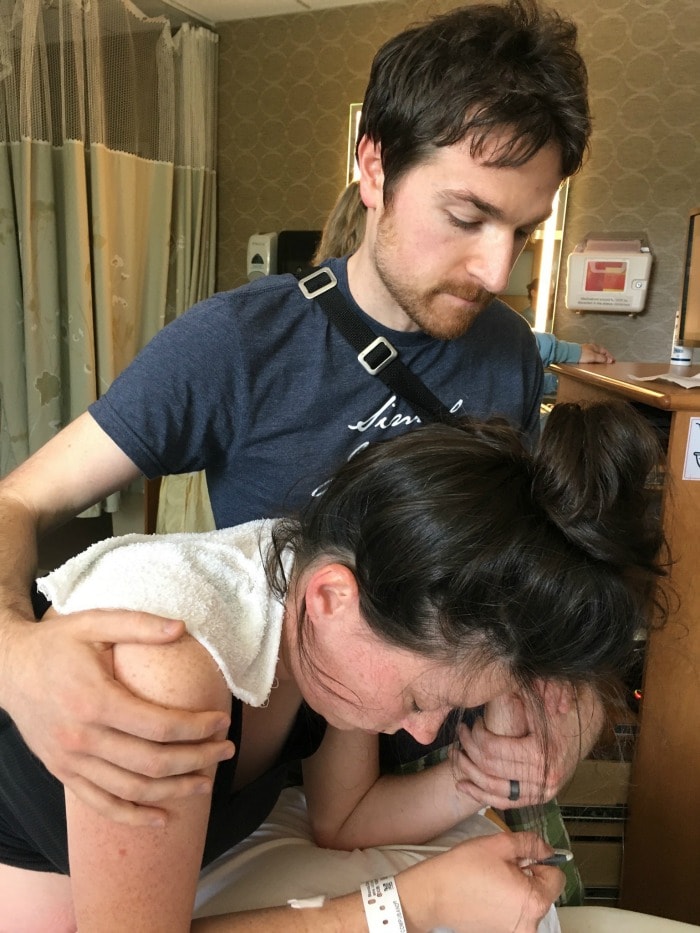
Time Out!
... which leads me to my next point. It's ok to go to the hospital! If you need to go to the hospital, you should go. If something isn't right, you should go. It's ok to utilize your support team and care provider. If you need medical advice, call your care provider or a nurse.
If you are laboring at home as long as possible because you are fearful - of the hospital and/or staff - you are laboring at home for the wrong reasons. Making decisions based on love - for yourself and your baby - instead of fear, is the way to go. Birth without fear!
If you don't feel safe, comfortable or trust your care provider or hospital, choose a new one! It's never too late to fire your OB!
(I know someone that switched care providers... DURING LABOR! Be brave and do what you gotta do to get things done safely and effectively.)
If you need to brush up on how to talk with your care provider and make decisions check out this post about the brain acronym!
Tips to Arrive to the Hospital During Transition
If you are hoping to labor at home as long as possible before heading to the hospital, odds are your goal is to arrive at the hospital at the end of the first stage of labor while in transition, or right before transition. The following are tips on how to do just that. Good luck!
1. Take a Good Childbirth Class
The foundation to laboring at home as long as possible is quality childbirth education. If a laboring mom is ignorant of her body, pain coping, the labor process, etc., how in the world is she going to navigate labor at home?
After completing a good childbirth class series you should have a solid understanding of how labor progresses, pain management for labor, and birthing tool options.
2. Hire a Doula
The next layer to successfully laboring at home is to hire a doula. A doula has witnessed many labors and is an invaluable asset when determining when to head to the hospital.
If I have a doula client that is unsure about whether to go to the hospital or not sometimes I'll just head on over to their home to check things out myself. FaceTime works too! Usually in less than 5 minutes I will know if it's time to go or not. A doula is so helpful in this situation!
3. Be Ready to Go
as long as possible is to be 100% ready to go at a moment's notice. When laboring at home, parents should not be packing a hospital bag, it should already be done. Phone chargers, wallets, pillows, a towel to sit on, etc., should be in the car ready to go while mom is laboring inside at home.
If the decision to go to the hospital is made, everyone should be able to get in the car and go in just a couple of minutes.

4. Notice the Timing of Contractions
An extremely effective tool to help determine when to go to the hospital is timing contractions. If you are unsure on how to time contractions, you can download an app! There are so many of them, and most are free.
Time Between Contractions
The first thing you need to look for is how far apart the contractions are. Contractions are measured from the start of one to the start of the next. Some parents wanting to labor at home as long as possible may go when their contractions are around 3-4 minutes apart.
Length of Contractions
Another way to know when to go is to notice how long each contraction is lasting. In early labor, contractions average around 30 seconds. During active labor, they increase in length to around a minute. During transition, they may be even longer at 90 seconds.
When your contractions are around 4 minutes apart and lasting 60 seconds or longer it might be time to head in to the hospital.
Duration of Contractions
One last aspect of contractions to consider when laboring at home is how long a particular series of contractions has been taking place. If you have been having contractions 3 minutes apart, each one lasting a minute, but this has only been going on for 20 minutes, you might need to time a few more contractions to make sure this is the real deal.
When in doubt, see if this pattern continues for an hour. If things are progressing, remaining intense, and not going away for the last hour, you might want to head to the hospital!
4-1-1 Contraction Rule
To put it all together, I suggest remembering the 4-1-1 contraction rule. When your contractions are 4 minutes apart, lasting for at least 1 minute, and this has been going on for 1 hour - you might want to go to the hospital.
Even then, there are more things to take into consideration when the goal is to labor at home as long as possible.

5. Notice These 3 Things
1. Notice Mom's Mood - Between Contractions
Sometimes, even when contractions are a solid 4 minutes apart, it's might not time to head into the hospital. One way to know what to do is to observe mom's mood BETWEEN contractions.
Normally, during a solid active labor contraction a mom works hard at coping, breathing, etc., but between contractions she's in a good mood, talkative and generally her normal self. However, when a laboring mom's mood BETWEEN contractions changes, that's when I start paying attention.
Here are some things to look for BETWEEN contractions that might signal it's time to take the drive to the hospital:
- She closes her eyes and goes within, even when not having a contraction.
- Stops chatting with family, friends or the birth team even between contractions.
- Annoyed at the chatter of birth companions, even between contractions.
- Becomes irritable, agitated and easily annoyed even when experiencing a break between contractions.
If her contractions are close together AND her mood between contractions has shifted, it's probably time to go to the hospital.

(If you look as pleasant as the woman above on the couch, it's not time to go to the hospital. 😉 )
2. Pay Attention to Mom's Pace
Another thing to notice when determining when to go to the hospital is how fast or slow the laboring mom is moving. In my experience, as a woman progresses through labor she moves increasingly slower.
I remember arriving at a doula client's home to help determine if it was time to head to the hospital or not. My client was in the tub, laboring through her contractions. At one point she got out of the tub to head on over to her bed. It took her forever to get to her bed! I quickly realized that she was progressing and suggested heading to the hospital.
Just as I anticipated, it took her awhile to get dressed, downstairs and into the car. Thankfully, she made it to the hospital with perfect timing and wouldn't you know it? She arrived in transition and soon pushed out her baby. Nailed it!

3. Notice When Mom Powers Off and Checks Out
If you are in labor but are able to continue texting and staying connected via social media, it's probably not time to head to the hospital.
As lame as it sounds, at my births... especially my homebirth, I had considered posting updates on social media via my phone. However, once things picked up and got intense, I honestly did not have the ability and/or brain power to stay connected. My phone was abandoned and I focused on my one task - have a baby!
If you're able to stay connected via your phone, it might not be time to head to the hospital.

Try to Stop or Slow Labor
If you're still unsure of when to go to the hospital, try to see if you can slow or stop your labor. If you can slow things down, you definitely should stay home.
Ways to Slow Labor
- Drink a glass of water
- Take a bath
- Take a shower
- Lie down for a nap
- Go to bed for the night
- Take a walk
If after trying the above activities labor has slowed or stopped, that can it's probably not time to go to the hospital. However, if you find labor remaining the same or becoming even stronger, it might be time to head to the hospital.

Signs of Transition
Here is a list of symptoms or signs of transition. If you are experiencing these things, coupled with the signs listed above, it's definitely time to go.
(For help coping through transition without an epidural read this.)
- Long contractions lasting around 90 seconds (in comparison, the average active stage contraction is around 60 seconds)
- Contractions become longer, stronger, and closer together - around 2-3 minutes apart
- Instead of completely going away contractions sometimes “double peak”
- Because of all this ^ it feels like you’re not getting a break. You may hear yourself say, “I’m not getting a break.”
- Hot and sweaty
- Cold and shaky
- Nausea
- Vomiting
- Crying
- Can’t find a comfortable position
- Contractions increase when changing positions
- Afraid to change positions
- Looking for a way out
- Water breaking
- Discouragement and/or giving up
- Irrational thoughts and behavior
- Asking for pain medication

"You'll Just Know"
A few times in my doula career I have received a phone call to go over to my client's home in order to help determine whether or not it was time to go to the hospital. While on my way there, I received yet another call saying that they decided to go in because it became obvious that it was time to go. They "just knew".
Sometimes, you just know. If you have a gut feeling that it's time to go to the hospital, then listen to that voice! Go make like a baby and head out! (lol lol lol)

No Car Baby, Please!
Of course, this article wouldn't be complete if I also explain how to get to the hospital without having a car baby. This is an important topic, especially for those that live out of town. Nobody wants to have a car baby! Use the link in this paragraph to learn more.

Want More?
For more juicy articles about rocking the hard parts of birth, try the how to's below.




I had had iffy labour over night and it just quit first thing in the morning, with a little show continuing all day. I took 2 gravol and lay down for a nap at 4pm, only to wake up "in transition" at 6! I can only describe the sensation as being stabbed awake! Not fun. My mood had changed and like you said, I just knew it was go time! The midwife checked me a little later and sure enough, I was 8cm! Pushed
For 9 minutes and had my little guy in my arms by 8:30! Amazing how our bodies know what to do!
This article is great, as a second time mom-to-be hoping to VBAC I really appreciated it. However, one aspect that wasn't addressed was timing regarding distance to hospital. I'm close to 50 minutes away from the (incredible, best in nation) hospital that I'll be birthing at. How does that change or affect our decision on when to leave?
Again, I really appreciate all of your points. Thank you!
I know for me personally, once you know you are in labor, I would head into town, maybe find something diverting to do nearby, or go relax at a park, that way you are close to the hospital, and you dont have to worry as much about whether you will make it there in time
I live 45 minutes from the hospital and this will be my second birth how would timing work to be able to stay at home as long as possible without delivering in a car? Lol.
On 11/16/16 I was 9 days past my due date. I went to my OB appointment where I learned I was 3cm dilated. The doctor I saw that day (first time I met him) was not thrilled with me because I had refused induction. After an ultrasound revealed my baby was about 10lbs he offered me a cesarean right then stating "with a baby this Big most women just get a C-section". Obviously, I politely refused. Much to his dissatisfaction, I went home. I told him I'd like to Labor at home as long as I could. He told me he thought it was a bad idea because he didn't think I'd make it to the hospital in time. Several hours later my contractions started getting stronger and more regular. Around 1am when they were about 3-4 minutes apart I decided it was time to go to the hospital. We arrived to the hospital about 2:30 or so. My Doula Taryn arrived shortly afterwards. Much to my dismay, upon arrival I learned I was only dilated to 4cm. I refused any medication. I did not want pitocin or pain medication. I had decided early on that I wanted to do my best to have this baby all natural. After a couple hours of extreme pain and discomfort I decided to let them break my water. As soon as I did things really started to move fast. That was the only thing holding her back and she was ready to come out! It hurt. It was hard. I cried. I cussed. I screamed profanities at my husband. I panicked. I slightly embarrassed myself. However, luckily I had a great midwife who got my attention and told me to chill out and focus. She was right, I started to lose control and that was what I needed to redirect my attention and focus on what I needed to do. Thanks to the help and support of a great team of people, my Doula, my husband, my midwife, & nurses, it only took a few more pushes to get her out. On November 17th at 5:11am, only about 2 1/2 hours after arriving to the hospital, Sawyer Quinn was born without complications. Weighing in at 9lbs 11.1oz and 21" long.
I had contractions for 4 days. At night they were every 10-15 minutes apart. So I got no sleep and was exhausted. During the day I had a contraction about every 45 minutes. Finally one night I started having contractions every 5 minutes apart for an hour. We pulled into the hospital at 1am when they checked me I was already dialated to an 8 and at 3:20am my son was born. So I wasn't even at the hospital 2 1/2 hours and I had my baby. First time mom!
You should add a disclaimer that if you've had a precipitous labor, you might want to head in sooner than you think! My first labor was 12 hours, but my second was a fast, induced labor - less than 2.5 hours from first painful contraction until she was born. I was dilated to a 4 from 34 weeks on with #3, so my OB told me not to wait around at home too long unless and joked that we didn't want my husband delivering her at a gas station. I started having contractions around 7am at 38+5, decided it was labor around 8, and left for the hospital around 9, still comfortable enough that I expected to be sent back home or told to walk. I felt a little embarrassed about coming in and had my speech all prepared for the triage nurse,- I was going to let her know that MY OB SAID to come in asap. lol. Both the nurse and I were shocked to find out I was 7.5. She didn't even think i was in active labor! I also never experienced the signs of transition that I'd heard so much about. I had one contraction in triage where I felt hot and pulled up my gown, but then after that, no hot flashes, no nausea, no otherworldly feelings. Looking back, I guess I was reluctant to change positions after getting to the hospital - the nurse offered a wheelchair, and I had every intention of using it, but after I stood up, it seemed easier walk to my room than to sit back down. I also never felt the urge to push, just some pressure. Natural labor was not what I had expected! My early contractions with my first were so painful that I just kept expecting things to get a lot worse. Anyway... I ended up delivering about an hour after arriving at the hospital, about 30 min after getting to my room, with no pain meds, so things were timed pretty perfectly. Unfortunately, I had wanted to be there, well, ideally for my entire labor (had induction scheduled for 39+1) and had decided while in early labor that I wanted an epidural. lol
I live 30 minutes away from my hospital on a mountain would it still be ok to wait until the 4-1-1?
I would check with your care provider on that one. There are so many variables to consider.
As at FTM this was very insightful. I want to have an un-medicated birth, but I am not sure how I will be able to handle the pain. I plan to labor at home as long as possible and this really breaks it down as to what I need to look for. Also, the other comments were very helpful as well, I love reading all the different stories!
For my second child, my first contractions came at 9pm the day before birth. I had start having what I though were my nightly Braxton-Hicks contractions, but these ones got stronger, and then I lost my mucus plug and knew it was the real deal. I stayed in the front room on our futon, and slept as much as possible. Sometimes the contractions would wake me up, sometimes not, so I mostly just rested. Around 10 the next morning contractions started changing and I wasnt able to talk through contractions anymore, so my husband took our kids to his mothers house and I continued to labor while relaxed on the futon. I watched my favorite shows drank lots of water, chatted with my husband as he frantically cleaned everything to cope with his anxiety, and ate small meals so as not to pack my stomach full. around 1pm I started getting really bad back labor. The only position I was comfortable in for contractions was my hands and knees, and I could feel myself slowing down, not really paying attention to TV anymore, and not talking quite as much. Then I distinctly remember around 3, I was sitting on the couch talking to my husband about when to head to the hospital, I had a contractions that dropped me to my hands and knees on the floor, and caused me to go totally internal to cope with the contraction for the first time in labor. When it was over, I looked at my husband and said, " its time to go, NOW." We arrived at the hospital at 4pm and I was dilated to a 3, was dilated to 10 by 6:30 and delivered my daughter at 7:29pm after 22 hours of labor. Which was an improvement from the 36 hour, difficult labor I had with my son. 😉
My first pregnancy I did not have any prior contractions and my water broke unexpectedly on it's on with no warning and unfortunately nothing was happening for hours so I needed pitocin. With my second pregnancy, I did not want to go through the experience of pitocin again. My labor started on its on at home. I started having contractions that were 10 minutes apart lasting 30 seconds in the middle of the night. I wanted to labor at home for as long as I possibly could. I laid on my side for the beginning contractions. As they grew more intense, I got on all fours and arched and stretched my back to ease the back labor I was experiencing. One way I knew it was time to go to the hospital was because I started being unable to talk through the contractions. I got to the hospital at 4:00 PM and my second son was born at 8:52 PM. I had really intense labor for about 4 hours - deep breathing techniques really helped me when the pressure became unbareable. I pushed from 8:30 to 8:52 when he was born.
First time Mom, and I am planning to labor at home as long as I can. However, we live about 45 min to an hour from the hospital depending on traffic and time of day. I definitely want to avoid an at home or car baby... with this length of drive, should we still be looking at 3-1-1 or 4-1-1? Or might we go slightly earlier? Obviously every labor is different, I'm just having a hard time figuring out timing once you are that far progressed. I don't have a doula, but my husband will be present as well as my Mom who is an RN.
Likely 411 will be A OK. But remember to pay attention to more than just the timing of contractions. Length, your mood, what you're saying or not saying, etc. Also GBS +/- results will be a factor as well. I'm sure you'll figure it out! And if you get there too early, just go home or walk the mall, etc. Good luck!
Gosh! I loved reading this, definitely keeping this tab open in my phone for when the time comes--just in case I need to look back or my husband does. Due in 17 days! I went into labor with my first 4 days early on my own and labored at home until I was at a 5.
I had not researched before so I didn't know how to do anything--unfortunately during transition (I didn't even know that was a thing until this pregnancy) I demanded a c-section. My body didn't take my epidural 3-4 times after redoing it so I felt I had no other choice. I knew it wasn't what I wanted but they gave me pitocin and that ruined the game after I was stuck at a 7 for awhile. I felt like I had to push before I went under General Anasthesia but I didn't say anything.
Going for a VBAC unmedicated waterbirth! Laboring at home and not going to fight the pain, like I did last time.
My question is, since I reached a 7+ last time how do you predict labor to go this time for my second baby? I'd say it was 12 hours all together from when I decided to go to the hospital from when I had my baby after my demanded c section.
Typically should it be about the same or faster?
I live 45 minutes away from my hospital I will be delivering at. I'm curious about when I should head to the hospital considering the drive time?
I am 27 weeks along. My first child was vaginal almost 6 years ago. I was at 4 cm after arriving at the hospital; my water completely broke in the parking lot. My son was born about 12 hours later. I had a baby by c/section 21 months ago because he was footling breech. Contractions were not painful until after a nurse examined me and pushed on my cervix. I was already scheduled for a c/section the next morning at 40 weeks, so my son was born that way. With there being such a small gap between pregnancies, my doctor is saying I am a candidate for VBAC for keeps throwing the c/section around due to that 1% risk he keeps bringing up. At this point, I am not trying to be fearful...it's coming naturally, lol. Would you make the same suggestions on home laboring for a VBAC? We live about 20-25 minutes away from the hospital....
I labored at home with my 2nd mostly because I was the only one home! Took a bath and it didn't stop the contractions. When getting out of the bath tub I had a couple drops of liquid running down my leg, I assumed water from the tub, but to my surprise it was my water. The contractions instantly got worse! My hospital was 40 minutes away and my husband was working 4 hours away. I finally found somebody to drive me and from the time I walked in the front door to the time I had him was 4 minutes. I walked myself into labor and delivery and when I got to a bed my midwife says you are.complete time to push! My husband missed his birth by 2 hours and I was in labor from the first contraction I felt to the time he was born was 4.5 hours. I was able to be on my phone up until the drive to the hospital. I was calling people and talking and texting..